

How can we help you today?
Pick the release your cluster runs, then search. Every page, command and manifest follows that release.
Not sure which release? It's the Cluster Stack your cluster uses. For a new cluster, use the latest: 1.36.
 New to Syself
Get access
to reach the management cluster, then connect your Hetzner account so Autopilot can create servers.- 1 Prerequisites
- 2 Access the management cluster
- 3 Connect your Hetzner account
- 4 Create your cluster
No account yet? Contact us for an account.
 New cluster
Create a cluster
We recommend the latest release, 1.36. Releases 1.35 and 1.34 are fully supported too.
The Cluster configurator is available from 1.36 onward. On 1.35 or 1.34, follow the step-by-step guide.
 I run a cluster
Fix, change or upgrade it
Keep the release on what your cluster runs now. Upgrade guides start from there and take you to the latest.
Everything here follows the release picked above.


Explore the Documentation
Guides and concepts for every part of your clusters. No sign-in required.
-
Concepts
Understand the foundations of Autopilot and how its clusters work.
-
Cluster management
Configure, update, and upgrade your workload clusters.
-
Servers and nodes
Manage the underlying servers and node pools running your clusters.
-
Networking
Choose how to expose applications and connect services.
-
Storage
Find guidance for persistent storage in your Kubernetes clusters.
-
Observability
Understand the visibility tools available for your clusters.
-
Workloads
Run and manage containerized applications and services on your clusters.
-
Security
Understand the security architecture of Syself Autopilot.


How Syself Autopilot works
You describe a cluster as a single Kubernetes object and apply it to the management cluster. Syself Autopilot builds the cluster, keeps it healthy, and upgrades it. Your workloads run on standard, upstream Kubernetes, on servers in your own Hetzner account.
-
Everything is declarative
You apply a manifest, and Autopilot reconciles your infrastructure to match it. It builds on Cluster API, the standard for managing clusters as Kubernetes objects.
-
Nodes are disposable
A node is never patched in place. For an upgrade, a fault or a security fix, a fresh node replaces it.
-
Released as a whole
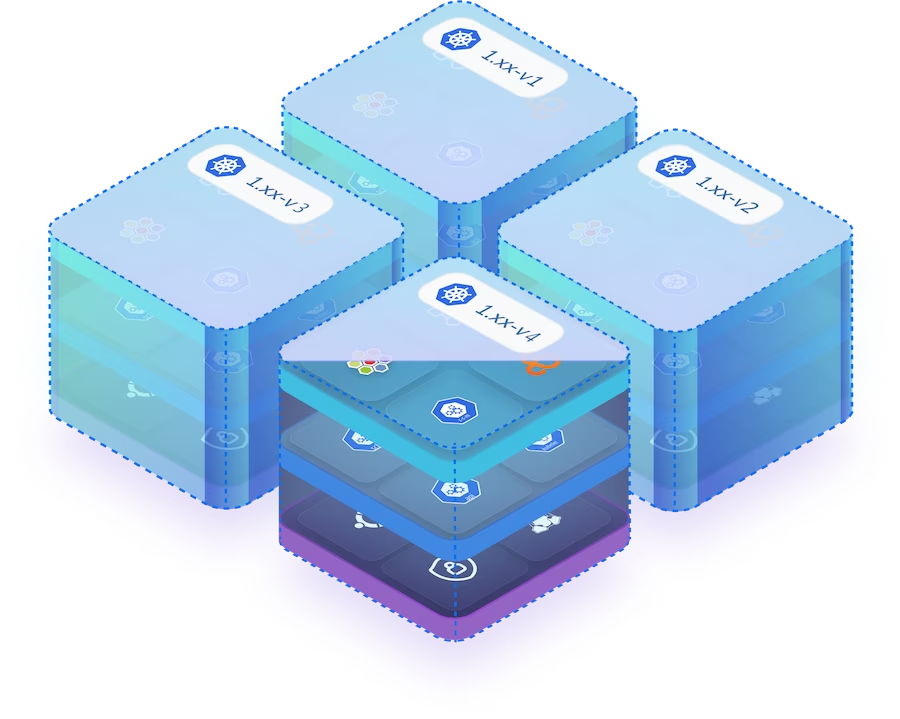
The node image, the cluster topology and every component in the cluster ship together in one tested Cluster Stack release.

Need help or have questions about your clusters?
Find a starting point in our guides or get in touch directly with our team.

Resources and links
Release information, open-source projects, and ways to reach us.
- Kubernetes Version Hub
Changelogs, fixed CVEs and support dates for every release
- Release notes
What changed in each Autopilot release
- CAPH (Hetzner)
Docs for our open-source Cluster API Provider Hetzner
- Get in touch
Questions before you start? Talk to the Syself team